
Nimbus remembers some of the work you leave behind. Customers can return, colleagues can cover for you, and tomorrow's inbox may contain a complaint about today's conversation. This chapter explains those connections. Optional story outcomes are folded below so you can learn the ordinary systems without reading the narrative endings.
TickIt: tickets versus open cases
A pending ticket is the classification task left by a concluded call. Log it under the right category in TickIt; it contributes to today's reporting and pay. An open case is unfinished business that follows an eligible career customer across days. Logging today's ticket does not automatically close a future case.
TickIt displays open cases above the logged history. Each entry identifies the customer, original scenario, reason, creation day and due day. Read this list at the start of a shift. A return arrives as an actual phone call, tied to the same customer's record and earlier issue; you do not close cases by clicking a checkbox in TickIt.
| Case reason | Typical return | On-time closure bonus | Why it opened |
|---|---|---|---|
| Callback promised | 1–2 days later | $6 | A legitimate customer could not provide details and you scheduled a callback |
| Technician follow-up | 2–3 days later | $9 | A technician resolution sometimes needs follow-up |
| Tier 2 bounced it back | 2 days later | $10 | An escalation is sometimes returned to your line |
| Caller hung up | 1–3 days later | $8 | A persistent customer abandoned an unresolved call |
| Account locked out | 2 days later | $12 | A real customer was incorrectly treated as fraudulent |
Technician follow-ups occur probabilistically, rather than after every technician dispatch. Tier 2 bounces are also probabilistic. A callback for an obvious security threat does not create an ordinary legitimate-customer follow-up.
Returning callers are less patient than first-time callers. Each overdue day subtracts four more starting mood, down to a bounded penalty, and reduces the case bonus by $2 until it reaches zero. On a return, the previous case is removed when that conversation ends. Successfully resolving it with at least 3 CSAT counts as a good closure and can earn the remaining bonus; a bad closure reduces morale. A new unresolved outcome may create fresh follow-up work.
Due cases also return during supervisor shifts. Promotion does not erase your earlier promises. Weekly reviews reward closing at least three cases and penalize leaving four or more open; see Career and progression.
Repeat customers and loyalty
Ordinary customer progress records contacts, resolutions, the latest result and loyalty. Good outcomes improve loyalty; bad outcomes reduce it. Low loyalty can make a customer return angry. These personal records differ from your office morale and coworkers' reputation.
Use CustomerDeck's record and intelligence/history information to understand repeat contacts. Existing-customer outbound renewals can improve loyalty, while pushy or fraudulent sales activity can worsen it. Records edited in Nimbus Directory persist in the active career and can affect future verification. Editing the stored details to match an untrusted caller is not a sound substitute for verification; follow Verification and diagnosis.
Complaints that arrive tomorrow
Bad calls can become later complaints. The game considers low CSAT, wrong proposals, dead air, false accusations and antagonizing the caller. Empathy, letting the caller vent, a legitimate goodwill action and a proper closing check can reduce complaint likelihood. They do not erase the underlying outcome or guarantee silence.
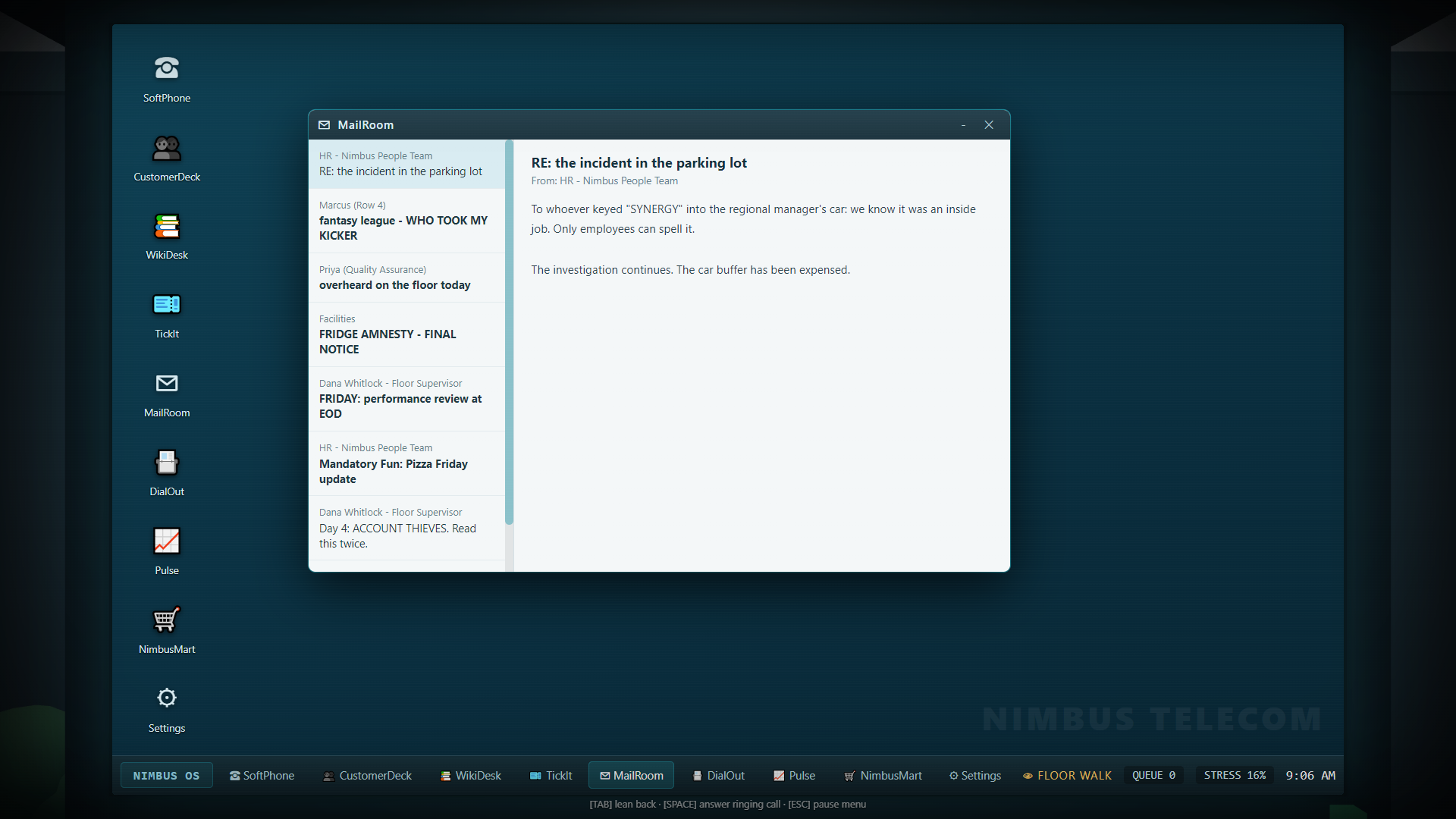
Read incoming MailRoom notices. Complaints affect your persistent complaint record and stress, so a call ending does not always mean its consequences are finished. Strong service reputation makes customers somewhat more forgiving. This is another reason to handle the person as well as the technical fault.
The floor's morale
Office morale ranges from 0 to 100 and starts at 50. It drifts two points toward the midpoint overnight. At the start of a career shift, morale below 30 gives new callers a −6 mood modifier; morale at least 70 gives +4. Good daily grades, caring for the office and helping colleagues can raise it. Neglect, rude behavior and some management decisions lower it.
High morale can also produce a small spontaneous perk: extra coffee, stress relief or a snack. This is a chance-based benefit, not a guaranteed item on every good-morale morning. Multiplayer and Night Shift do not run the ordinary persistent morale loop.
Marcus, Denise and Sofia
Each Pod 2 coworker has a separate 0–100 reputation toward you. From day 4 onward, a colleague may email asking you to cover two resolved calls. Doing so during that shift earns trust and morale plus the stated coffee or lookout benefit. Helping on a special working day can earn more reputation.
Meaningful reputation landmarks include:
- Marcus at 25: he may quietly take up to two ordinary calls off your schedule before the shift gets underway.
- Sofia at 50: she can keep Fernando Jr.'s watering streak alive when you miss a day.
- Any coworker at 75: they can stop Chad's queue-poaching attempt.
You can also spend goodwill to transfer a ringing ordinary career call. The coworker who likes you most must have at least ten reputation; the transfer costs six reputation and is available twice per day. It clears that call without a miss penalty. It is a triage option before answering, not a way to move an active conversation.
An unanswered Tier 2 transfer is a separate once-daily option: it deducts a $4 routing fee, reduces stress and clears the ringing call. These career triage options are unavailable in ordinary multiplayer and Night Shift. Multiplayer's Team Coverage system has different rules, described in Multiplayer.
Caring for the physical office
Lean back, look at a hotspot and click it:
- Fernando Jr.: water once per day. At a three-day streak he aids passive calm; at five he flowers. Watering raises morale and Sofia's reputation. Skipping a day can wilt him and break the streak unless Sofia helps.
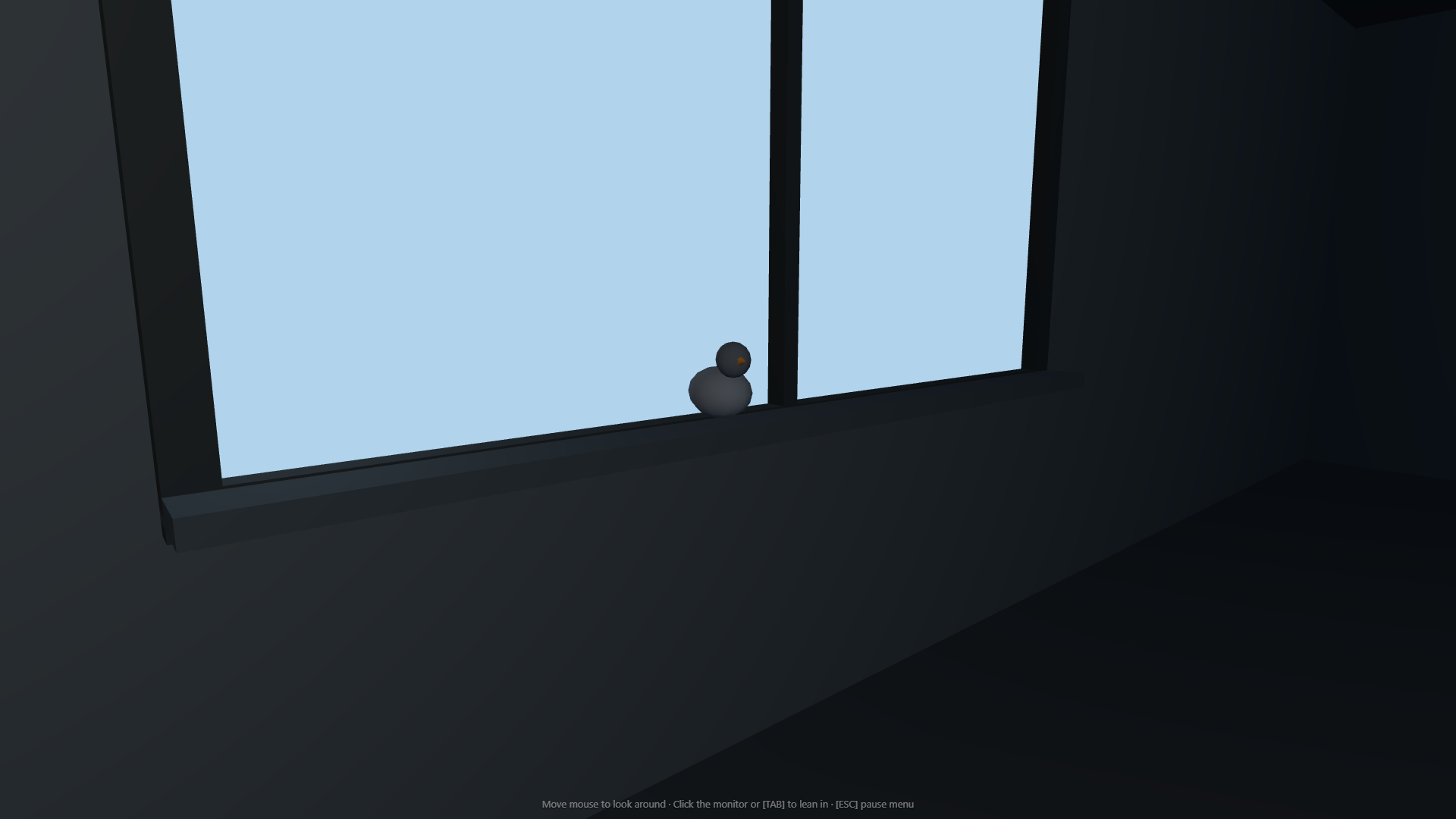
- Gerald: feed the pigeon when he is available. Doing so relieves eight stress and improves morale.
- The Hungry One: the printer gives warning before a jam. Clearing it early avoids the failure and helps morale. Fixing an actual jam pays $2 and also helps morale.
- Pin board: read the sticky notes and expandable newspaper clippings for practical hints and office lore.
- Coffee and vending: use the mug, breakroom machine and VendX Pro for recovery; the phone still matters while you are away from the screen.
Ambient paper planes and background antics are office activity, not an undisclosed playable aiming game. There is no requirement to click every animation. Money, stress and home covers the mechanical desk and recovery benefits.
Working conditions and interruptions
Career modifiers are announced ahead of their shift and are not selected as Night Shift memos. Check their instructions before acting:
| Special day | Effect |
|---|---|
| Corporate Audit | Clean resolution pay ×1.5; grift risk ×3 |
| VIP Day | The queue routes VIP customers with their associated pay and expectations |
| Rolling Outage | Callers start less happy; pay ×1.6; intermittent outages |
| Double Shift | Twice the configured calls, pay ×1.5, no break |
Baseline special-day eligibility begins with VIP Day from day 6, Audit and Rolling Outage from day 8, and Double Shift from day 9. They are occasional conditions, not a fixed weekly rotation, and are not rolled on consecutive days.
An ordinary system outage pauses queue delivery while CustomerDeck is unavailable. A fire drill pauses the queue and provides temporary relief. A call storm adds three to five callers at shorter spacing; surviving its bonus window without a new miss can pay $25. A cascade failure is deliberately different from a paused outage: CustomerDeck, WikiDesk and TickIt fail in sequence while calls continue arriving. Watch the actual notice rather than assuming every IT incident pauses the phone.
Chad and Pod 4
Pulse compares your completed-day performance with Chad's, and each five-day review compares averages. A strict win pays an extra $40; a tie is not a win. The day-15 showdown doubles the leaderboard prize to $80. Wins and losses are tracked in your career. Repeated wins make his rivalry more personal, and strong coworker trust can protect your queue from his attempts to poach it. Winning five reviews earns a change in his response to you.
This rivalry uses completed-day scores. Selling more leads does not directly override a poor daily service grade in the comparison.
Story spoilers: D.D., leverage and Compliance endings
D.D.'s arrangement
Data exports and other off-book activity can produce an envelope under your desk the next morning. Collecting it is a physical office interaction. Payments change as D.D.'s arrangement develops. From day 6, enough dirty income can unlock bulk exports; a later associated caller tests whether you approve or report suspicious activity. Helping the arrangement can open a limited wire-transfer opportunity.
These options remain grifts with fines and warnings. Later in the arrangement, involvement in multiple transfers plus an existing warning can lead to betrayal and a career ending. Other paths conclude with D.D. going dark. Accepting a supervisor promotion ends an active early arrangement and removes its envelope. Supervisory paperwork still has its own risky options, but that does not mean the earlier deal continues unchanged.
What you overhear
A misdial can let you listen to compromising information. After hearing enough, a later email offers a one-time decision: keep it as insurance, sell it or report it. Keeping the information creates a single-use opportunity to remove a misconduct warning once one exists. Selling pays $120 off the books and can increase D.D.'s interest. Reporting can lead toward Compliance cooperation. Correcting the misdial instead does not reveal that same leverage.
Whistleblower path
Flagging an associated suspicious caller, reporting leverage or qualifying for a later clean-career contact can offer cooperation. Accepting starts a five-day investigation sequence with daily mail. Completing the sequence leads to a restructuring ending with $500 severance and its career milestone. It is an authored career ending, so do not choose it expecting permanent immunity and an otherwise endless unchanged job.
Special-caller spoilers: unusual lines and surreal events
Calls with their own resolution
Pranks, wrong numbers, an anonymous informant and unusual recurring callers are not ordinary account faults. Use their specific conversation options rather than forcing every call through a router reset.
The anonymous caller can be heard out or appropriately directed; they do not become a verified customer merely because you opened CustomerDeck. The Regular returns across up to five career encounters, with at least three days between eligible visits. Reassurance is his helpful path; dismissing him gives a different result. He is a recurring nuisance and is not removed by switching off surreal office events.
Glitch is deliberately subtitle-led and unvoiced. Hanging up through its specific option is the intended resolution. The 3:33 event temporarily stops the displayed clock, alters the audio atmosphere and introduces a silent call. Its own wrap-up options resolve it and restore the event. Missing spoken audio for these two authored scenarios is not proof that the voice installation failed.
Surreal office events
The optional dread layer begins later in the career and increases with off-book involvement; Night Shift uses wave depth instead. Flickers, strange printed pages, phantom ringing and Invoice's behavior can occur. The phantom ring only appears when the line is actually quiet. Check SoftPhone's real state before interpreting it as a missed call.
Ordinary faults, bills, security threats and The Regular have their own systems. The stock pause menu does not currently expose a separate switch for this surreal layer; camera sway and scanlines can be adjusted independently in Video settings.
Achievements and hidden milestones
Open Trophies for earned and available milestones. Secret entries remain hidden until earned. Career, Night Shift and multiplayer have different achievement scopes; scratch playtests and community experiences do not farm ordinary career awards. Community packs can add local trophies with their own criteria. Steam integration is separate from your in-game viewer, so use the troubleshooting chapter if the client or account is offline.