
Career mode follows your working life at Nimbus Telecom. The first five days introduce the queue, sales, suspicious callers and a performance review. Passing Friday does not finish the game: later days continue indefinitely, introducing a wider caller pool, special working conditions, repeat customers and longer-term progression.
For the first shift, follow Getting started. This chapter explains what the numbers mean and how an ordinary agent develops into a specialist or supervisor.
The first week and the endless queue
The baseline schedule is:
| Day | Label | Scheduled calls | Minimum scheduling gap | Handling-time target |
|---|---|---|---|---|
| 1 | Monday | 5 | 18 seconds | 150 seconds |
| 2 | Tuesday | 7 | 14 seconds | 140 seconds |
| 3 | Wednesday | 8 | 12 seconds | 130 seconds |
| 4 | Thursday | 9 | 10 seconds | 120 seconds |
| 5 | Friday | 10 | 9 seconds | 110 seconds |
These are starting configurations, not a promise that the phone rings at perfectly regular intervals. Calls can wait behind an active caller, and training, events, follow-ups and modifiers alter the day's workload. The handling-time target encourages efficient work; it is not a rule that automatically ends every call at that exact second.
After day 5, baseline volume grows toward 16 calls. Scheduling gaps fall toward 6 seconds and the handling target falls toward 85 seconds. The weekday label repeats every five days. A Friday review therefore happens on days 5, 10, 15 and so on.
Read MailRoom before starting serious work. Tomorrow's modifier can be announced in the previous report, followed by a morning email. Spend and train with that workload in mind.
Pulse: your performance dashboard
Open Pulse on the desktop to see calls taken, resolutions, average CSAT, earnings today, strikes, missed calls, misconduct warnings, cold sales and office morale. The recent-week table shows completed days; the career footer shows lifetime days, resolutions, scams foiled and earnings. Later, Pulse also contains your service tier, Pod 4 rivalry and supervisor controls.
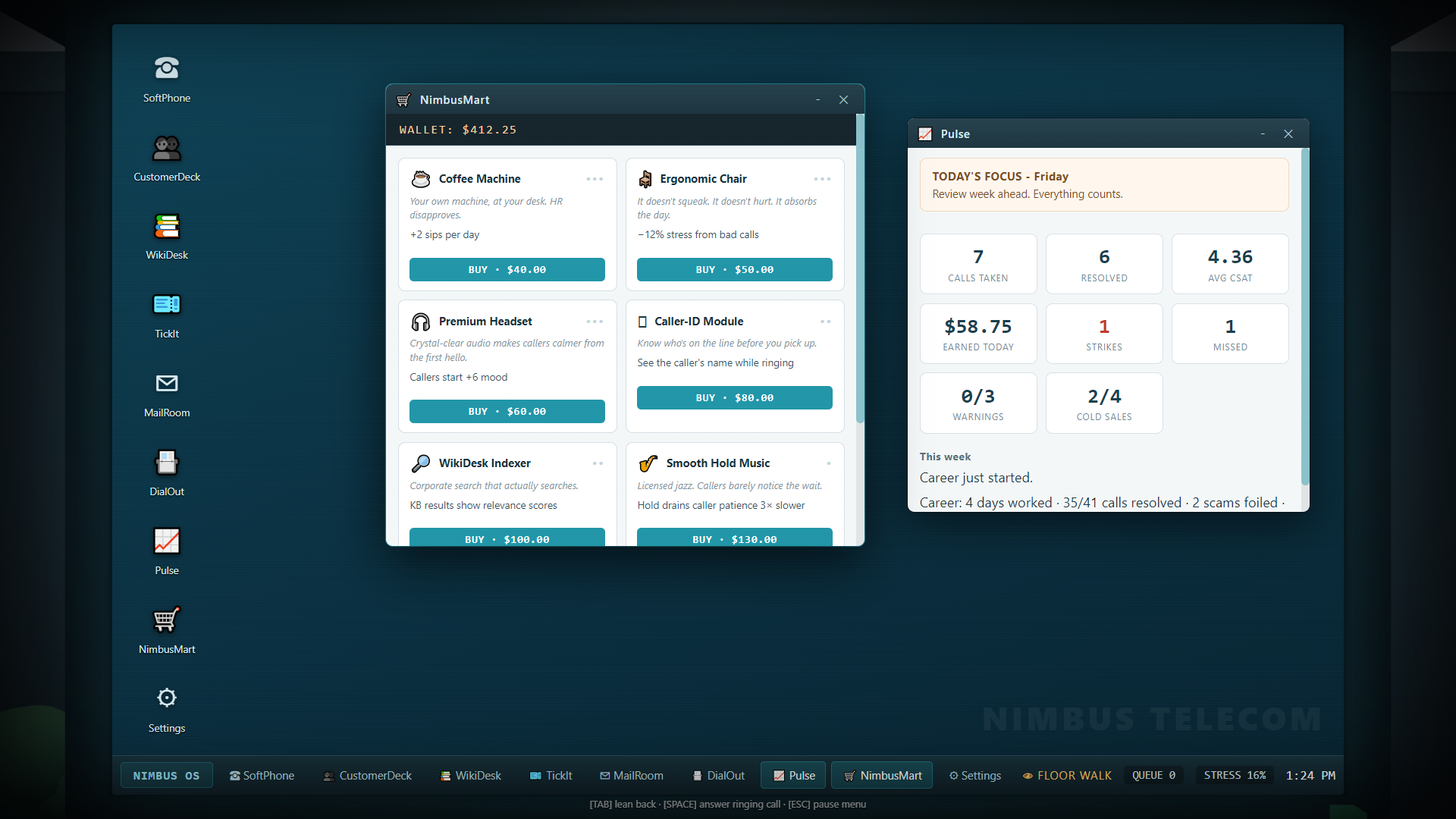
Keep these measures separate:
- Taken counts concluded calls you handled. A caller who hangs up still contributes to the day's outcomes.
- Resolved counts successful outcomes, including appropriately handled security and certain special calls. Promising an ordinary callback is not a completed resolution.
- Missed records ringing calls that were not handled, including deliberate drops where applicable.
- CSAT is the average of rated handled outcomes, on a five-star scale.
- Money today is income recorded during the shift. Your wallet also reflects spending, fines and other payments, so the two totals need not match.
- Strikes are shift-scoped compliance failures. Warnings persist across the career and concern misconduct. One is not a synonym for the other.
How the daily grade is calculated
Your daily score is calculated at clock-out:
Score = (average CSAT / 5 × 60)
      + (resolved calls / scheduled calls × 40)
      − (strikes × 8)
      − (missed calls × 4)
      − (unlogged tickets × 2)
The result is bounded between 0 and 100. The resolution denominator is the scheduled workload, not just the calls you answered. Avoiding difficult calls therefore does not create a perfect resolution rate. Call storms, routing and similar events can change that workload.
| Daily grade | Minimum score |
|---|---|
| S | 92 |
| A | 82 |
| B | 70 |
| C | 55 |
| D | 40 |
| F | Below 40 |
For example, CSAT 4.5, eight resolutions from ten scheduled calls, no strikes, one miss and one unlogged ticket produce 80 points: B. Fixing the logging alone raises that result to 82: A. Finishing more callers well remains more valuable than rushing through them for a larger earnings number.
When the queue finishes, clear pending work in TickIt. If tickets remain, the game enters wrap-up and offers CLOCK OUT. You may leave them unlogged, but each pending ticket costs two score points. Correct ticket categories also earn money; see Handling calls and Money and stress.
Weekly reviews
Every fifth day, management grades the average score of the latest five completed days. Weekly thresholds differ from daily thresholds:
| Review | Minimum adjusted average | Bonus |
|---|---|---|
| S — Floor Legend | 90 | $120 |
| A — Top Performer | 78 | $80 |
| B — Solid Week | 65 | $50 |
| C — Meets Expectations | 50 | $25 |
| D — Needs Improvement | 35 | $10 |
| F — Under Review | Below 35 | $0 |
More than five callbacks in the review period subtract five points from the weekly average. Closing at least three open cases adds three points; having at least four cases still open subtracts four. These adjustments are bounded to the 0–100 range. A callback is a legitimate fallback when identity cannot be established, but repeatedly putting problems off affects the review.
The review also settles enabled recurring bills, compares your performance with Chad and checks progression milestones. Keep enough cash for bills before spending the review bonus. Follow-up discipline is explained in Cases, characters and events.
Service tiers and resolution mastery
After at least three completed days, the average CSAT of up to your most recent five days determines the service label in Pulse:
| Tier | CSAT average |
|---|---|
| Platinum | At least 4.8 |
| Gold | At least 4.5 |
| Silver | At least 4.0 |
| Bronze | At least 3.5 |
| Unranked | Below 3.5, or insufficient history |
Platinum is a rolling status, not a permanent certification. Holding it across ten consecutive completed days awards its career milestone. Separately, a full review week averaging at least 80% first-contact resolution unlocks Expedite Solutions: a persistent 5% pay premium on ordinary resolved calls in that career.
Certifications
Open NimbusMart → CERTIFICATIONS. Each of four tracks has three sequential tiers costing $200, $600 and $1,500. Buying a tier immediately records its benefits and books training for tomorrow. Only one course can be booked at a time. The training shift has roughly half the normal baseline queue, with a minimum of three calls; other modifiers can still affect it.
| Track | Tier I | Tier II | Tier III |
|---|---|---|---|
| Technical | Eligible advanced faults; +5% resolved-call pay | +10% resolved-call pay | +15% resolved-call pay |
| Retention | Resolved cancellation CSAT +0.3 | +0.6 | +1.0 |
| Compliance | Verification-question mood penalty reduced 30% | Reduced 60% | Same 60% reduction, plus one strike waiver per shift |
| Sales | Upsell acceptance +8 percentage points; commission +10% | +16 points; +20% commission | +25 points; +30% commission |
Certification bonuses are the current tier's total, not the sum of all earlier tiers. Technical content can have certification prerequisites, so the course also changes what can route to you. Training is a career system; it is unavailable in ordinary multiplayer and Night Shift.
Becoming a supervisor
Two consecutive A or S weekly reviews trigger an HR promotion offer delivered by email. A weaker review interrupts the streak. Accept or decline from MailRoom; promotion is a choice, not an automatic switch after ten days.
Supervision retains the ordinary tools and much of your queue. Baseline personal call volume becomes approximately 60% of the day's configured queue, with a minimum of three. On top of that, other agents hand up real escalated callers. They may already be angry because someone used the wrong fix or left them in silence. Treat them through SoftPhone, CustomerDeck and WikiDesk as genuine calls.
Open Pulse → SUPERVISOR — FLOOR CONTROL:
| Morning posture | Trade-off |
|---|---|
| PUSH FOR VOLUME | Around 30% more scheduled work; pay ×1.25; morale −8 |
| RUN IT STRAIGHT | Normal allocation and no posture modifier |
| PROTECT THE TEAM | Lighter schedule, pay ×0.85, wider spacing; morale +10 |
Choose once per shift. Protecting the team trims the remaining schedule, while pushing adds callers. Set posture early enough for it to influence the day's remaining work.
You can coach Marcus, Denise, Sofia or Chad twice per shift. Each session advances shift time by 45 seconds, adds coaching credit and raises morale; coaching Pod 2 also improves their reputation toward you. Accumulated coaching reduces the number of future hand-ups and makes a coached agent less likely to escalate. The cost is time: callers can stack up while you are coaching.
When an agent complaint appears, TAKE THE HIT puts it on your complaint record while improving their trust and floor morale. DOCUMENT IT assigns the complaint to that agent and lowers morale and, for Pod 2, their reputation toward you. This is a management decision with consequences, not a free morale button.
Supervisor pay includes a $55 base salary, adjusted by office morale and the average reputation of Marcus, Denise and Sofia. The performance adjustment can be negative, with a −$20 lower bound. Salary is paid at the completed-day report, alongside the other economic systems.
The current dismissal rule records each D/F supervisor shift and dismisses you when that counter reaches two; a better intervening day does not reset that counter. Do not assume a strong day erases earlier poor supervisor results. After three supervisor shifts, HR offers a return to your former role. Returning is a recorded career choice.
Career endings and what remains
Four counted compliance strikes in one shift end the career. Three misconduct warnings also end it. Two consecutive daily F grades cause performance dismissal. Some optional narrative choices have their own endings. A dismissal removes the active career slot; its wallet and purchased career equipment do not carry into a replacement career.
Achievements and the local prestige track remain separate from the slot. Prestige records completed career days across careers:
| Lifetime completed days | Honorific |
|---|---|
| 10 | Probation Survivor |
| 25 | The Grinder |
| 50 | Pod Legend |
| 100 | Compliance Nightmare |
These titles do not automatically grant a wage increase. When a career ends, prestige remembers your best coworker reputation. A new career can inherit one quarter of that remembered warmth, rounded down and capped at 15 per coworker. Night Shift and multiplayer do not bank career prestige days.
For the persistence boundaries, modded careers and backup behavior, read Saves, settings and troubleshooting.